I work in a creative field and have nothing left for my own art
Why this happens
This is not regular burnout. Regular burnout is when you're too exhausted to do anything. You're exhausted too — but that's not the core problem.
The core problem: your brain has fused "creating" with "work." Psychologists call this a conditioned association. You use your creativity for clients all day. Deadlines, revisions, briefs, feedback. Your nervous system learns the pattern: creative mode = performance mode. Evaluation. Pressure. Delivery.
Then you sit down to make something for yourself. Your brain doesn't see "personal project." It pattern-matches to work and activates the same stress response — the tightness, the inner critic, the need for the result to be good enough. That's why it feels like forcing. You're not out of creativity. Your brain is protecting you from what it thinks is more work.
The pattern isn't just one thing. It's a chain: the tool, the time of day, the place, the posture, the way you start, the expectation of a result. Your brain recognizes the chain and fires up work mode. You don't need to replace every link. You need to break enough of them that your brain stops recognizing it as work.
How to break the chain
- Build a personal ritual that can't exist at work. This is the most important step. You need 2-3 anchors that your brain will learn to associate with "safe mode" — not work, not performance, just you. Pick a specific music or playlist you never play during work hours. Pick a specific drink that's different from your work drink — if you drink coffee at work, make it a specific tea, or hot chocolate, or anything that's only for this. These aren't decorations. They're neurological signals. Your brain will learn: this sound + this taste = different mode. Give it a week or two and the switch starts happening automatically
- Start every personal session with one minute of garbage. Before you touch your project — open your tool and make something worthless. The ugliest face you can draw. Random color splashed across the canvas. Scribble with your eyes closed for 30 seconds. This is a palate cleanser. At work, the first thing you do is always purposeful — open a brief, start a task. One minute of intentional garbage sends your brain a signal it never gets at work: there are no stakes here. The work pattern fires up, hits this wall of nonsense, and breaks. After that minute — open your real project. Same tool, but your brain is already in a different mode
- Don't start right after work. Not because you're tired — because your brain doesn't switch off the moment you close your laptop. Give yourself a gap. A walk, a shower, cooking — something physical and non-creative. The length doesn't matter as much as the break itself. Then sit down with your ritual anchors (music, drink, garbage minute) and begin
- If you work from home — this matters double. Your brain has tagged your desk, your chair, your room as "work environment." Every surface carries work associations. For your personal creative time, change something physical. Different chair. Different side of the table. Laptop on the couch instead of the desk. Even facing a different direction. It sounds trivial — it's not. Your brain associates physical environments with specific modes. Same desk = same stress
- Protect the project from becoming work. The moment your personal project gets a deadline, an audience expectation, or a "should" — your brain reclassifies it as work and the stress returns. For now: no posting, no deadlines, no "I should finish this by Sunday." The project exists only for you. The moment you catch yourself thinking "I could show this to someone" — notice it, and let it go. That thought is the work brain trying to take over
When I want to draw for myself, I pick up a pencil and open a paper sketchbook. No screen, no layers, no undo. Just a pencil and whatever comes out. Nobody sees it. There's no post at the end, no story, no caption to write.
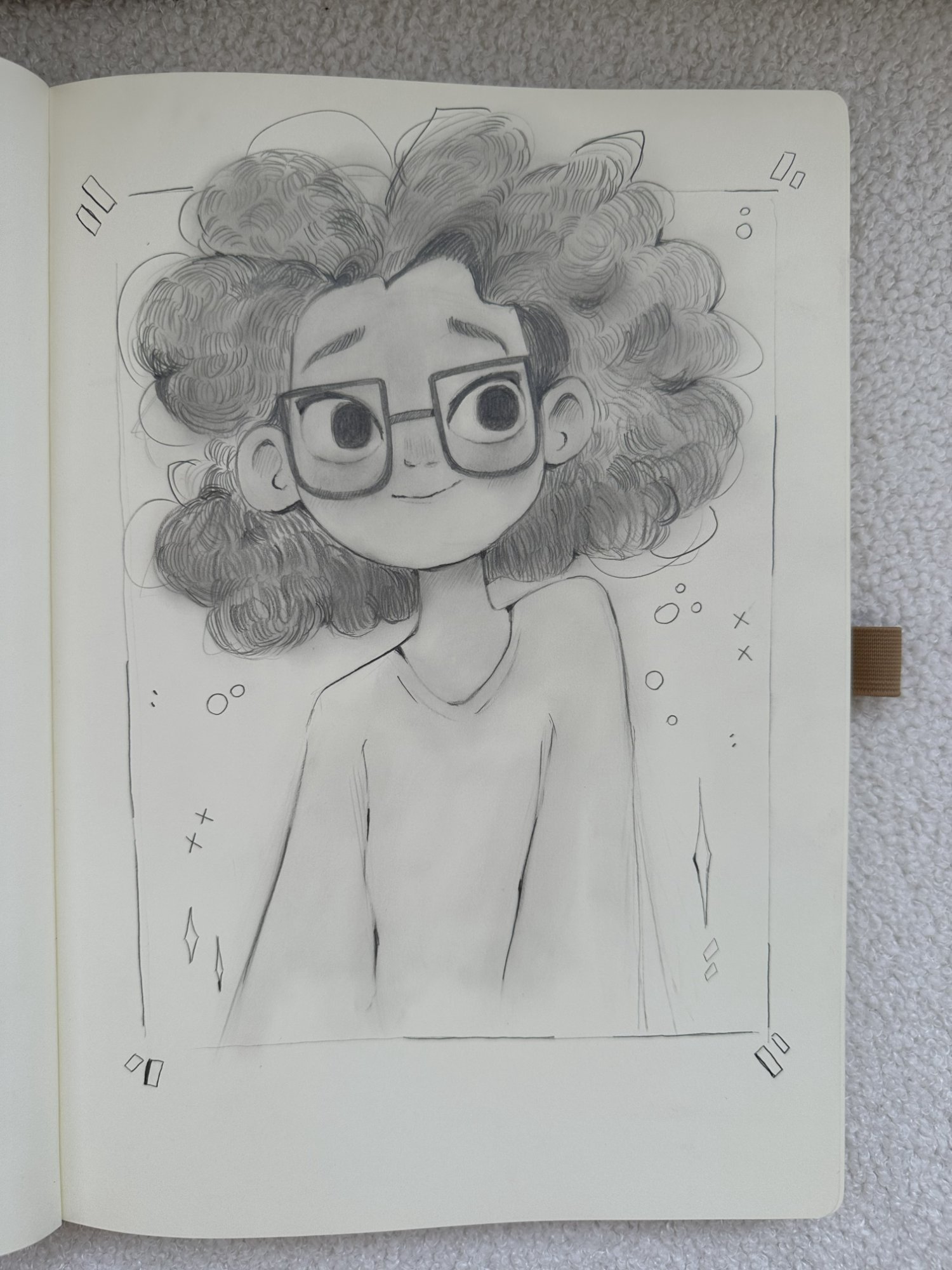
These sketches are the loosest, most imperfect things I make. And you know what? One of them ended up on the cover of ImagineFX magazine. The thing I made with zero pressure, for no audience, with the "wrong" tool — turned out to be the most alive thing in my portfolio.
That's what happens when your brain isn't in work mode.
Want more than a quick fix? I break down problems like this in detail — real drawings, real process, step by step. Tutorials & breakdowns on Patreon ✨